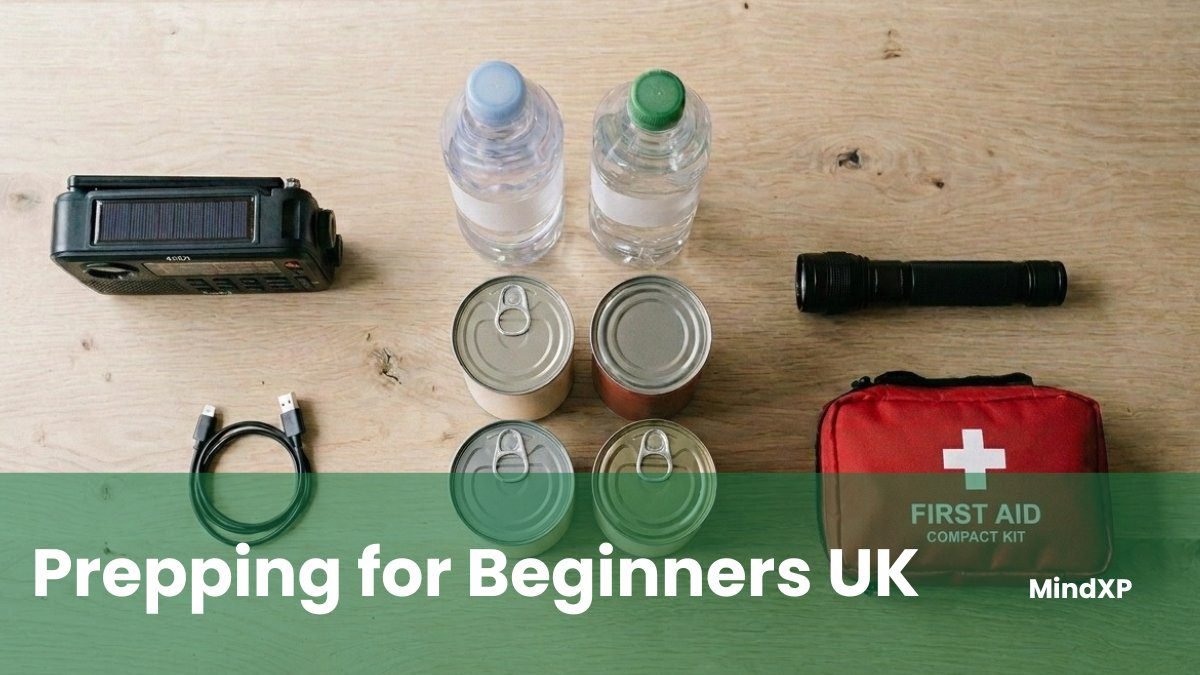
In America, prepping has a long history. In Britain, our ‘Keep Calm and Carry On’ attitude clashes with the whole idea of prepping.
So, why are millions of British families doing it?
War feels closer to home, supply chains are more fragile, civil unrest keeps flaring up. The UK Government is now encouraging households to keep emergency supplies.
There’s nothing wrong with investing a few hundred quid in your family’s safety. This guide breaks down what you’re actually preparing for in the UK, what you need, and how to get started, plus useful tips from real preppers.
In this guide
What you’re preparing for (real UK risks)
The word prepping makes us think of nuclear fallout shelters, tinfoil hats, and piles of canned goods, but the reality is much more practical. Instead of preparing for specific events, create a backup for every critical capability you could lose in any emergency.
Think systems, not scenarios.

A flood, storm, or fire can all produce the same problem: a power cut. So, the same prep covers all three. Let’s look at some plausible UK risks and how to prepare for them:
Power cuts
The most common emergency on this list by a mile. Most power cuts last a few hours, but that’s still long enough to leave you without heating, lighting, hot food, or a phone.
Storm Arwen left some homes off-grid for over a week. According to the BBC, those affected struggled with staying warm without electricity most of all, followed by a shortage of water.
Storms & flooding
Flooding is the UK’s most common natural disaster, though not every flood turns into an emergency. When it’s serious, you might be forced to either hunker down or leave on short notice, so you need adequate supplies for staying put and a 72-hour bag for bugging out.
Another risk associated with flooding that’s hard to predict and even harder to prepare for is the mental health risk. A report by the National Emergencies Trust found that 69% of flood victims suffered mental health effects.
For those in high-risk areas, knowing a warning system is in place can help ease some anxiety. Register for this free service to get flood warnings from the Environment Agency.
Supply & fuel disruption
Recent events have revealed the fragility of our global fuel supply. The UK relies heavily on lean supply chains sourcing fuel from abroad, meaning geopolitical events that are out of our control can directly affect us.
Choked supply means high prices, food shortages, panic buying – the works. But none of that matters when you’re already sitting on a couple weeks’ worth of food and fuel.
Civil unrest
It’s rare, but it can happen. The 2011 riots are an obvious example. These events are usually local and short-lived, but they pose a real risk for those living and working in cities. The best approach is to treat the chaos like a natural disaster and avoid it completely where possible.
The prep is basically the same as with other emergencies: stay informed, stay home, and stay stocked up. You don’t need anything new; the same food, water, and cash that cover a power cut cover this too. The single best move in any unrest is simply not being there.
Conflict & national emergencies
The government now openly advises households to prepare for national emergencies, including the possibility of conflict, that’s new, and it’s why you’re hearing more about preparedness in the news.
The practical response isn’t bunkers; it’s the same 72 hours of self-sufficiency that covers everything else on this list. We’ve covered how to prepare for war in the UK in full.
The 5 things that always matter
While it can be a good idea to prepare for certain specific risks, almost every survival situation depends on the same core essentials.
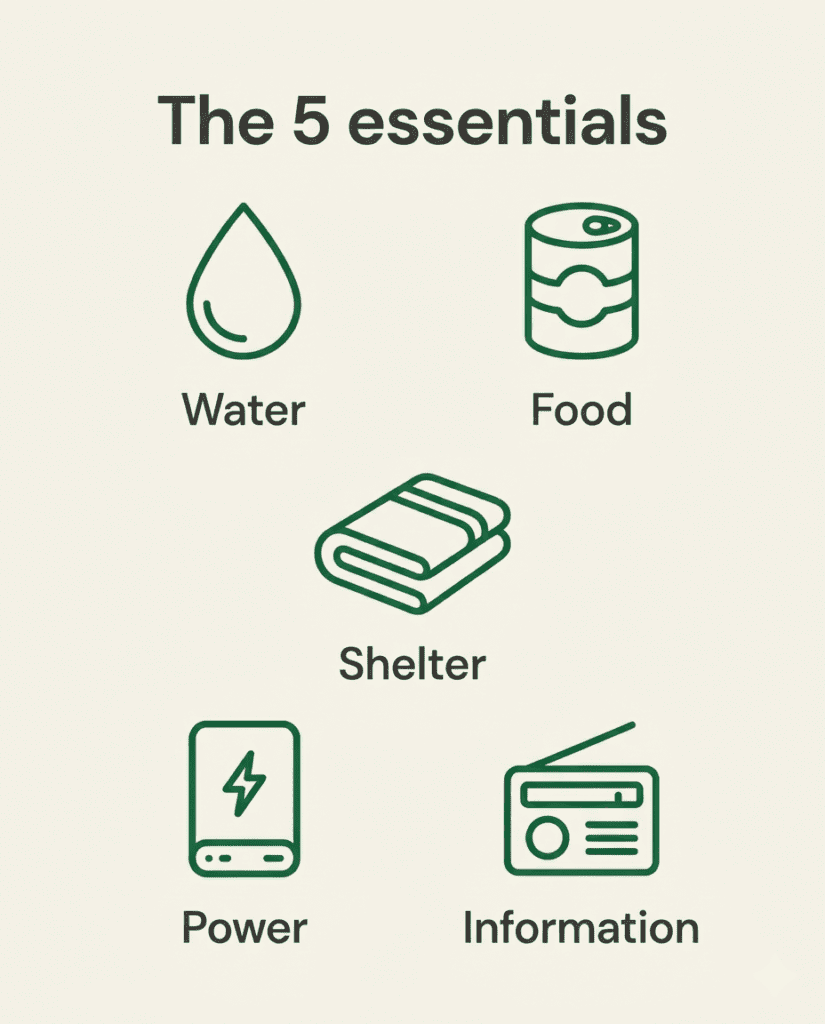
Water
You can last about three days without it, less if you’re exerting yourself.
The WHO recommends a minimum of 2.5 to 3 litres of drinking water per person per day for survival, and around 10 litres per person per day if you want enough for cooking and basic hygiene too.
It’s a good idea to store what you need at home and buy filtration/purification products for your 72-hour bag.
For how much to keep per person, the cheapest ways to store it, and how long tap water lasts, see our full guide on how to store water for an emergency.
And if you ever need to make unsafe water drinkable, here’s how to purify water in an emergency and the best water filters for emergencies.
Food
Two-weeks’ worth of food stored away is a good rule-of-thumb. Add a few extra long-lasting items to your regular shopping list to build up your stash gradually.
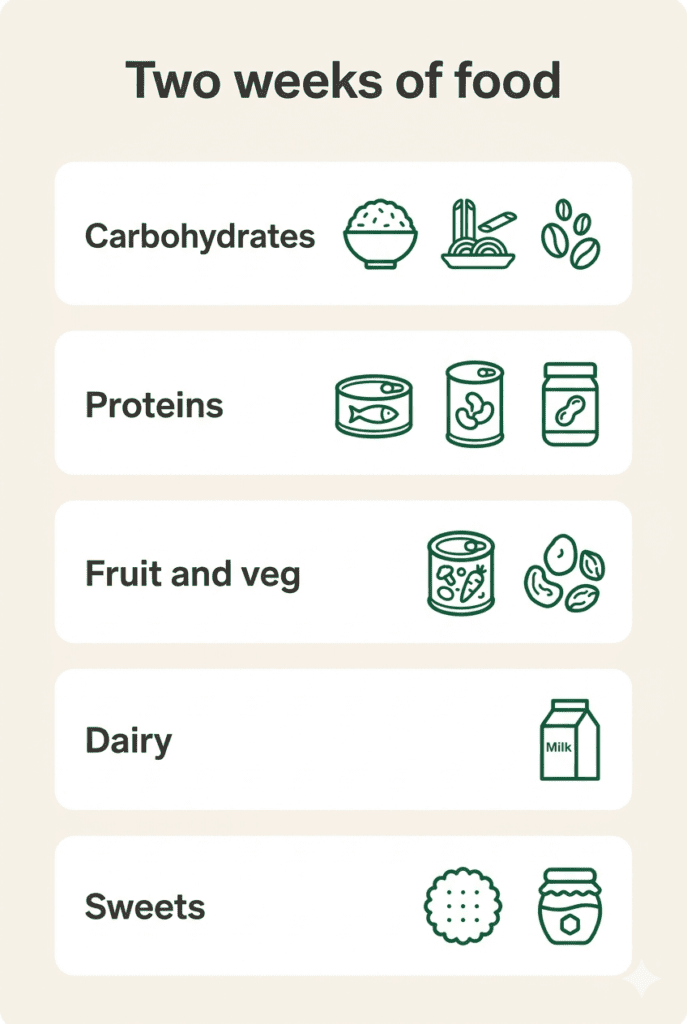
Think in categories instead of individual items:
- Carbohydrates: Rice, pasta, rolled oats, noodles, and couscous.
- Proteins: Tinned meat and fish, beans, and nut butters.
- Fruit & veg: Dried and tinned fruit, tinned vegetables, vegetable soups.
- Dairy & alternatives: UHT and powdered milk.
- Sweets: Honey, biscuits, crisps, and confectionery.
The trick is to treat this as part of your normal shopping, not a separate stockpile. Buy what you actually eat, use the oldest first, and replace as you go, so it stays fresh and nothing gets wasted.
For the complete method, including how much to store and what the government recommends, see our guide on building an emergency food supply.
Shelter
Shelter is the survival term, but what it really means is staying warm. This only really becomes a problem in the context of a power cut, since central heating needs electricity to run, even with a gas boiler. So a winter blackout leaves you cold as well as dark.
The fix isn’t electrical: blankets, warm layers, and shutting into one room to hold the heat, so you’re not waiting on the power coming back before you warm up. We’ve covered this properly in our guide on how to stay warm without heating, and if you want a serious backup, here are the best non-electric heaters.
Power
Nowadays, a power cut is often the most consequential emergency. No power means no heating, no refrigeration, no electronic devices, no access to online banking, no lighting, no communications. The situation is even more serious for those who rely on electrically powered medical equipment at home.
A power bank keeps your phone going through most short cuts, which matters because that’s how emergency alerts reach you and how you stay in touch. For anything longer, or for keeping essential equipment running, a portable power station does more. As with water and food, cover the basics first and build up from there.
For more on power cut preparation, check out our guide on how to build a power cut kit.
Information
In an emergency, you need to know what’s happening, where your loved ones are, and what to do. Mobile networks can get jammed or fail during serious emergencies, making your phone useless.
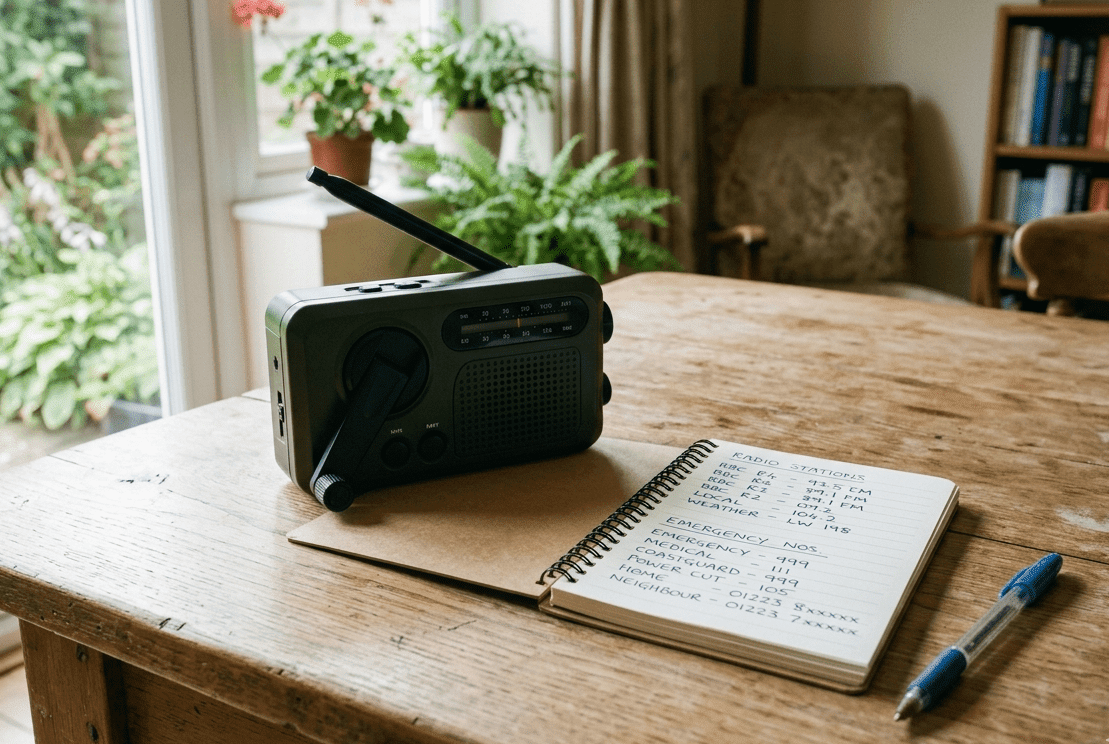
For updates on what’s going on outside, a battery or wind-up radio is your best option. Write down the frequencies of your local and national stations and keep them with your emergency numbers. Radio frequencies are area-specific, so look yours up sooner rather than later.
For staying in touch when local networks are down, agree on a single out-of-area contact everyone can check in with, and text rather than call, since messages often get through when calls will not.
The 72-hour kit: your grab-and-go bag
The 72-hour kit is a staple in prepping circles. Not only are they quite fun to build and customise (speaking from personal experience), but they’re also extremely handy. If disaster strikes, you’re ready to survive at the drop of a hat.
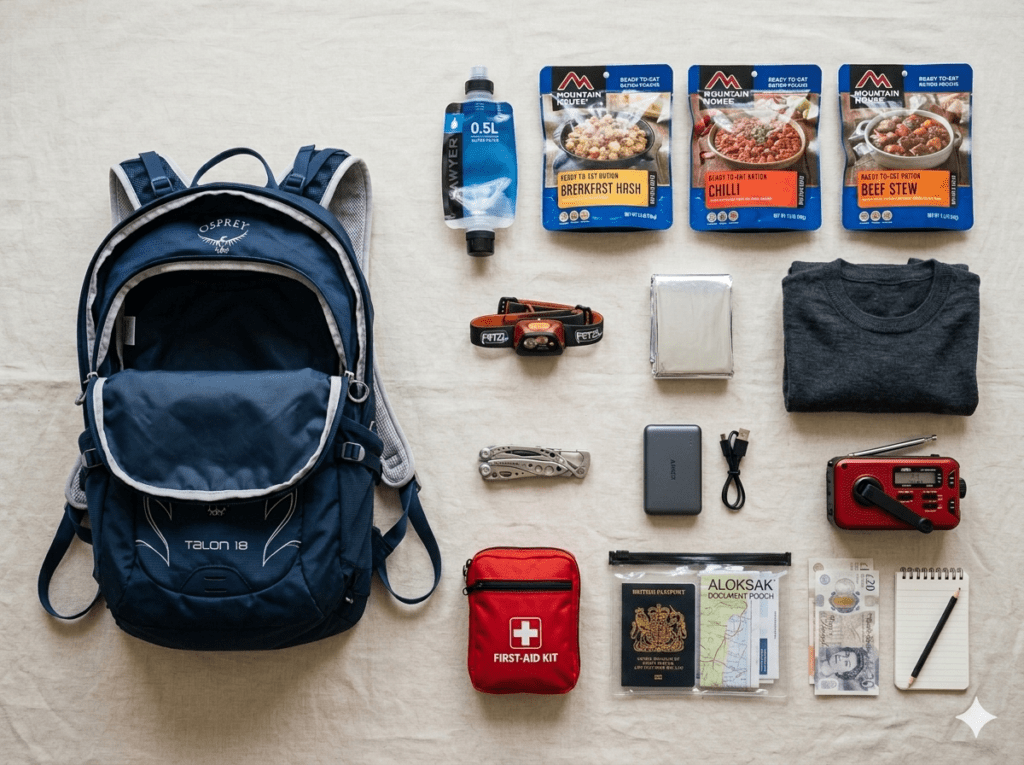
The idea is simple: three days of essentials in one bag you can grab on your way out the door. It’s the portable version of everything above, sized for one person leaving the house rather than a household staying put.
Here’s what a typical bug-out bag includes:
- Food & water. Think purification (chlorine tablets) and filtration systems (Sawyer Mini) instead of bottled water. Lightweight ration packs that don’t need cooking.
- Light. A head torch, plus spare batteries. Solar and wind-up torches are great too.
- Warmth. Space blankets are cheap, compact and effective. Fire-building equipment is also a solid backup option.
- First aid. Purchase or build a small first aid kit and pack a few days’ worth of any medication you take regularly.
- Documents & cash. Essential documents like ID and insurance in a waterproof bag, along with some cash in case card payments are down.
- A multi-tool. A decent multi-tool will come in handy in ways you cannot yet predict, all in a lightweight format.
- Radio. A wind-up or battery radio for updates if the network drops.
This is worth a guide of its own, so when you’re ready to start properly, here’s how to build a bug out bag.
How to start prepping in the UK
Prepping works best as something you build gradually and keep on top of. Here’s how I’d start:
Step 1: Audit your preparedness
First, see what you already own. Check cupboards, drawers and any camping gear and note what’s already useful, like tinned food, a torch, a camping stove, blankets.
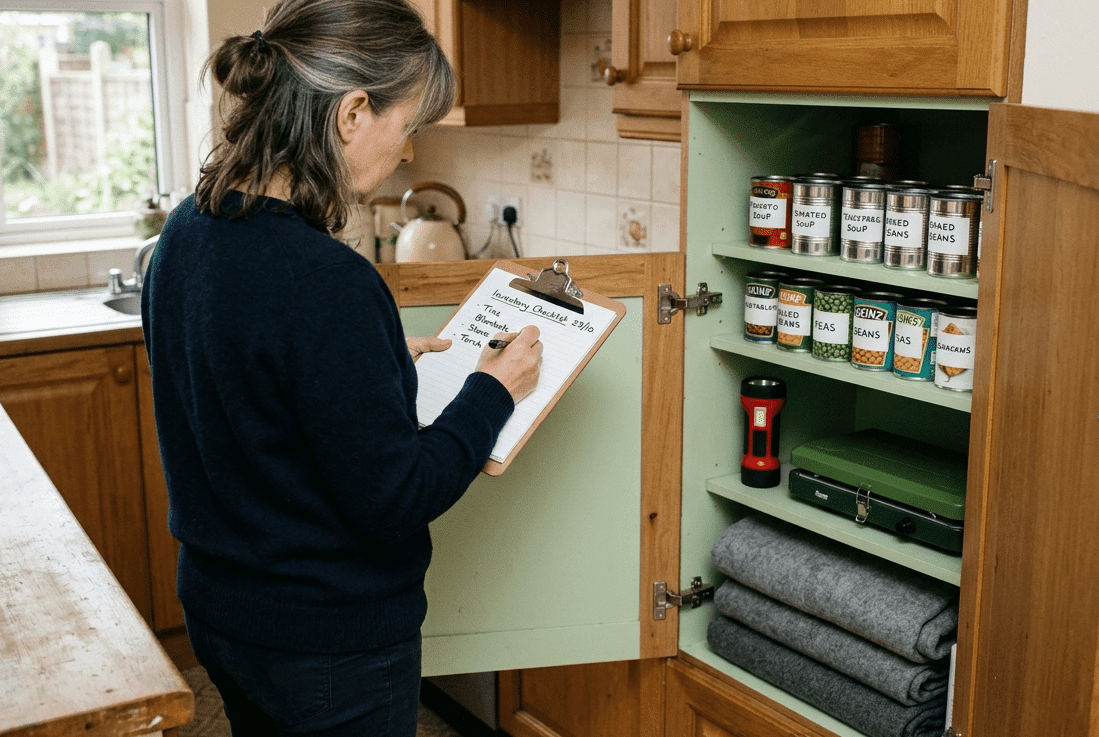
Then run the audit. Work through it in three columns: the risks you face, what each one takes away, and what covers the gap.
| What could happen 💭 | What you’d lose ❌ | How to prepare ✅ |
| Power cut | – Heat – Light – Hot food – Phone – Fridge | – Blankets – Torch – Power bank – Long-life food |
| Storm / flood | – Road access – Use of your home | – Grab bag – Flood warning alerts – Somewhere to go |
| Supply / fuel disruption | – Easy access to food – Fuel at the pumps – Cash from machines | – A fortnight of food – A full-ish tank – Some cash |
| Civil unrest | – Shops – Transport – Services locally for days | – Stay-put supplies – Stay informed – Stay home |
| Water interruption | – Clean tap water | – A few days’ stored water – A filter |
Then add your personal risks, the ones that don’t apply to everyone:
- At risk of flooding? Check your address on the government flood risk service and sign up for flood warnings.
- Rely on electric medical equipment or fridge-stored medication? Make backup power a priority and join your energy supplier’s Priority Services Register.
- Babies, elderly relatives, pets, or mobility needs? Add their specifics, formula, spare medication, pet food, a carrier.
- No car or a small flat? Lean towards staying-put supplies and compact kit, since leaving or storing a lot is harder.
Fill in that table for your own household and you’ve got your prep list, before spending a penny. Everything after this is just working through it.
Step 2: Accumulate the essentials
Now start building up the five essentials from the section above:
- Water
- Food
- Warmth
- Power
- Information
But don’t buy everything in one go. After your audit, keep an eye out for the things that matter.
Add a few long-life items to your normal shop. Grab some extra batteries and a torch. Start collecting things like single-serving milk, sugar and ketchup, which are pure gold when you need them.
Step 3: Build your grab bag
A grab bag covers your basic needs if you ever need to leave in a hurry. Focus on compact, portable solutions. You can also clip carabiners to the outside of your bag to extend its capacity, giving you somewhere to secure a sleeping bag or something else.
- Start with the bag. A comfortable 15-25L backpack does the job, no need for tactical gear. Mine’s a Berghaus 15L. Around £30-50 gets you something that’ll last.
- Add three days of the essentials: A filter or purification tablets (plus a bottle to drink from), ready-to-eat food, a head-torch, a foil blanket, and a warm layer.
- Pack the documents: Copies of your ID, insurance details and key contacts in a waterproof pouch. Add some cash in small notes, and maybe a physical map depending on where you live.
- Pack tools & equipment. Pack a multi-tool for the dozens of small jobs that come up, a power bank to keep your phone and light running, and a radio for updates when the network’s down.
Keep it somewhere obvious by the door, and you’re ready to move in seconds rather than scrambling.
Step 4: Keep it topped up
Prepping is a habit you keep ticking over. The whole thing runs on one simple loop:
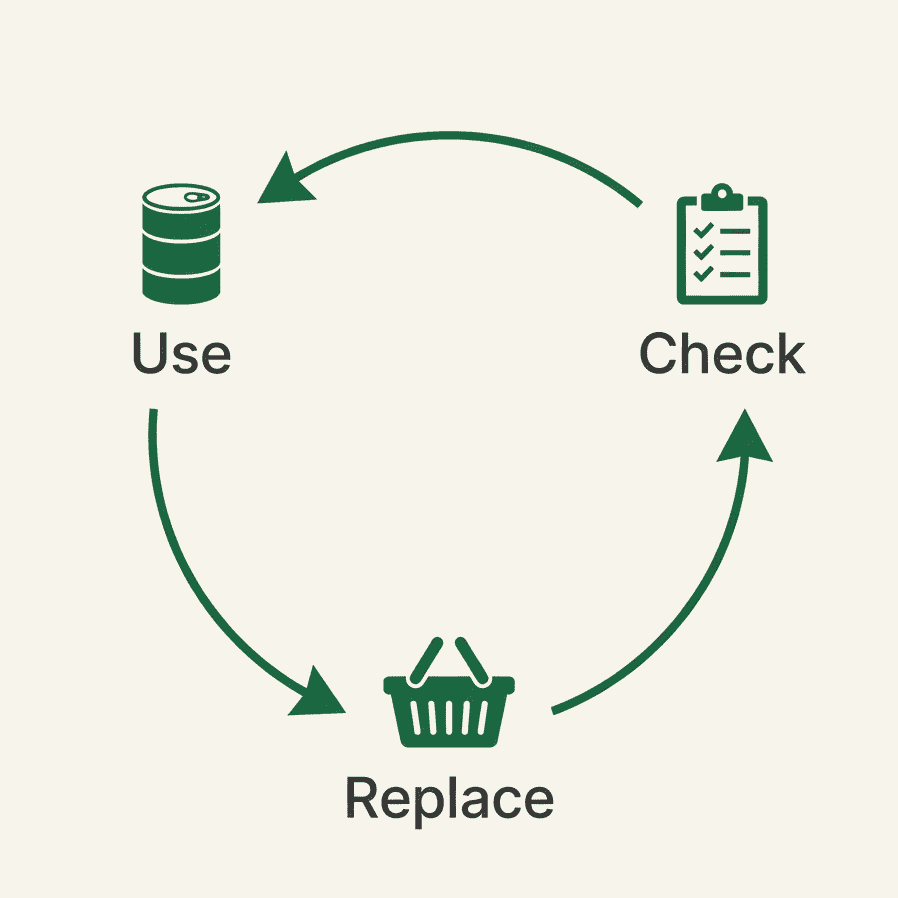
- Use the oldest first. Eat and drink from your stash in date order, then it’s never sitting there going off, it’s just your normal cupboard with a bit more depth.
- Replace what you use. Whatever comes out goes back on the next shop. One in, one out, so the level never drops.
- Check every few months. A quick once-over: expiry dates, battery levels, anything borrowed from the grab bag and not put back. Set a reminder so it actually happens.
Do that and your supplies stay fresh, your kit stays ready, and the whole thing maintains itself in the background.
Beginner mistakes to avoid
Prepping involves a bit of trial and error. You never know exactly what you need until the time comes. That said, there are some obvious beginner pitfalls worth avoiding:
- Gadgets over basics. Prepping is big business, and there’s a fancy gadget for everything. What starts as sensible prepping turns into James Bond cosplay if you’re not careful. So, put down the night-vision goggles and get the boring basics first.
- Complexity over simplicity. The more complicated the tool, the harder it is to maintain and the more likely it is to break. You need simple, proven, durable tools. Often, simple items like a pocket knife or a torch become the most useful kit during emergencies.
- Buying everything at once. You don’t need to spend a fortune this weekend. Build it up gradually, a bit on each shop, and it sticks as a habit instead of fizzling out.
Keep calm & prepare
Prepping should make you feel better, not worse. Don’t obsess over worst-case scenarios. The whole point of prepping is being ready for emergencies so you don’t have to worry about them.
I’ve turned everything here into a printable 72-Hour Family Prep Checklist, so you can work through it at your own pace instead of trying to remember it all.
Pop your email in and it’s yours. I’ll also send the occasional update worth reading, new guides, seasonal reminders, and the odd kit recommendation.
FAQs from UK preppers
Here are some of the most common questions people ask when they first start prepping in the UK:
How do I prep in a small flat with no space?
The essentials during a power outage are water, food, and power. If you’re seriously short on space, get a box of energy-dense ration bars, a few water bricks under the bed, and a power bank. For your 72-hour bag, think purification tablets instead of water, items that double as other items like mess tins, and pocket-sized survival gear.
Will my boiler work in a power cut?
Almost certainly not. Most UK gas boilers and central heating systems need mains electricity for the ignition, pump and controls, so when the power goes, the heating goes too, even though your gas supply is unaffected. This is why blankets and warm layers matter as much as a full gas tank.
What should I stockpile first in the UK?
Water and food you already eat, in that order. A few days’ drinking water, then a fortnight of long-life tins and dry goods built up gradually. The same supplies cover a power cut, a storm or a supply shortage, so you’re not preparing for one specific disaster.
What are the most common prepping mistakes?
Panic-buying in one go, storing food and water you never rotate, spending big on gadgets before owning a basic torch, and forgetting basic essentials like a manual tin opener, spare medication and cash. Build slowly, use what you store, cover the basics first.
Can I store fuel or gas canisters in a rented flat?
Check your tenancy agreement first, as many restrict storing petrol, gas canisters and similar fuels indoors, and for good reason. A small camping gas canister is usually fine, but keep quantities low, store them ventilated, and never stockpile fuel in a flat.
Do I need to prepare for my pets?
Yes. Keep a few days of pet food and any medication they need, plus a carrier and their vaccination records if you might have to leave. They’re part of the household, so they’re part of the plan.
Is prepping normal in the UK?
Increasingly, yes. It’s shed most of its bunker-and-tinfoil image as more people have lived through power cuts, storms and shortages. The Government now actively encourages households to keep emergency supplies, which has done a lot to make it mainstream.
Has the UK Government told people to prepare?
Yes. The official Prepare campaign on gov.uk encourages every household to keep emergency supplies and make a basic plan, listing items like a torch, power bank, wind-up radio, water and non-perishable food.

Professional writer and editor. Founder of MindXP, helping UK households prepare for power cuts, storms, and supply disruptions.